01
THE FILM
The purpose behind a film must always be to tell an important story
The first draft of Awaken was completed in April 2016. The script started to come together in February that year when director Kyle Parish's grandfather, Doug Battams, was diagnosed with terminal cancer. The film was to be vessel, in which all the emotions you experience while losing someone, would go into. It would be a deep dive into those most human concepts of loss, grief and love. While the film would go through 3 rewrites, the core of the film stayed the same, a journey of self discovery after the loss of someone who you don't know how to live without.
The main character of Eve was wrote to be someone everyone could relate to. As she goes through her journey of learning of her mother Miranda's terminal cancer diagnosis, to her passing, to coming to terms with death, we are taken on a journey that feels all too real. Eve is surrounded by a supporting cast of characters that each try to help her recover, with some making things worse and some making things better. This dynamic created a very real feeling experience where the characters actions feel like something you could experience in your own live. And finally, we have to add in the pressure and stress of daily life. In this case, it's the enormous responsibility Eve carries as the lead scientist studying a comet that will pass so close to Earth you could almost touch it. While the comet itself isn't something that's part of daily life, it's discovery and meaning for Eve leads her down a path of self discovery.
At the true heart of the story though is the greatest mystery of life and that is the question of what happens to us when we die. It is a question that at some point in life we all ask, we all struggle to answer and we all are forced to come up with an answer to. That struggle to find an answer is the core of this film. Where do we go? Does life just end? Is there a heaven? This is the question that Eve must answer in a way that fits her core beliefs in life. As the audience watches this film, they will explore possible answers to this question and it's the hope that everyone will be able to relate or maybe even be helped with this quest for an answer to life's oldest question.
By December 2025, Awaken had finished it's final touch up's and was ready to go into production. Most importantly, this final version of the story allowed the audience to explore themselves just as Eve is exploring herself, with an ending that makes you truly think. If this film can help someone deal with their own loss, then it has done it's job.

02
THE FACTS
It takes a team to make a film
To say that bringing Awaken to life would be challenging would be an understatement. Parish Productions is a small independent film studio with limited resources. But it's in this kind of environment that we come up with new and better ways to bring our dreams to life. That starts with an amazingly talented cast of actors that had the range of skills to bring these characters to life. Then you mix in the production team and you end up with magic. But the biggest difference with this project was it's overall size. While this is not our first feature film, it is our first feature to come within a few minutes of a 2hr runtime. Where our last feature, Fallen Star, required extensive use of a virtual production studio setup to create other world environments, this film needed to be done all on real practical sets, with VFX being used for visuals of the comet, but integrated into practical shots. The script brought it's own set of challenges in terms of the emotional stresses our actors were going to be put through every single day. All of this combined to make for a challenging shoot, but one where everyone rose to and exceeded our hopes.
- Abby Wolfe was the first actor cast in the project, having a draft of the script over a year before filming began. Abby would also be the only actor to be on film every day of filming.
- Casting was completed in August 2025.
- Location scouting began in October 2025. 3 different houses, 1 cottage, 1 observatory, multiple university offices and classrooms and 1 high school classroom were required for filming.
- When not on camera, cast members would be preparing food and taking on other behind the scenes responsibilities. The vast majority of the crew had multiple roles, as is common on independent film sets.
- Filming days ranged from 9hrs on the lightest day to 16hrs long on the busiest day.
- There were two camera rigs on set, one consisting of a Canon C200 cinema camera with a 24-70mm F2.8 lens. Attached to the rig was a Atomos Ninja V+ recorder, a Rode NTG Shotgun mic, and video transmitter, while the second consisted of a Canon R5C cinema camera with a 24-70mm F2.8 lens and also attached to a Atomos Ninja V+ recorder, Rode NTG Shotgun mic and video transmitter.
- Over 13TB of live footage was recorded during filming.
- Filming wrapped on May 11th, 2026.
- The entire filming process was filmed for a documentary about independent film making. Bonus Disc Films, lead by Olivia Bronwyn, took lead on this project.


03
THE SCIENCE
This film is a science first science fiction film
While Parish Productions has been fairly exclusive to the Science Fiction and Fan Film genre from the very beginning, this film is not fantasy sci-fi. This film is real world science sci-fi. what we mean by that is that the science and the concepts discussed in this film are very real and required research to make sure what we setup in the film is actually possible in real life.
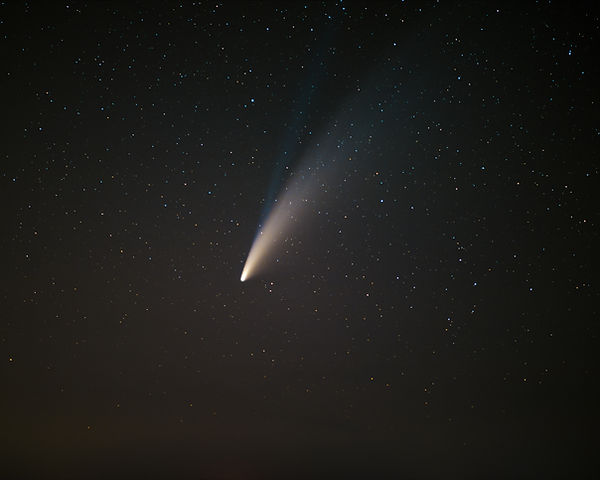
From the earliest concepts of Awaken, there was always a comet. These space snowballs, with their beautiful glowing tails, have the ability to capture your imagination. So when choosing what space event would grab Eve's attention, it was easy to choose a comet. But we didn't want a normal one. This had to be special. The last truly great comet was comet Hale Bopp in 1996/97 and to this day it's images are breathtaking. We wanted that but much bigger. So the idea of having a very large comet that comes from outside our solar system was created. When the script was first wrote in 2016, we hadn't actually detected any interstellar space objects passing through our solar system, however that changed with the discovery of object 1l/'Oumuamua by Canadian Astronomer Robert Weryk. Also similar to our comet, this object made a close flyby of the sun and stayed on a linier course, not being affected by the suns gravity. The biggest difference between our comet and this object was size. Our comet would be huge, nearly 90km in diameter, larger then both of Mars moons, and it would be taking a path that brought it between the Earth and the Moon.
While we know that in theory an object of this size can come from outside our solar system, can be a comet, and can move at a speed and path to avoid gravitational effects, we don't have a clear idea what this would look like from Earth. Movies in the past have shown comets to be extremely bright and colorful in the night sky as they get close to Earth. But when we look at comets we see in real life, they tend to look a bit different. Normally you need a camera using long exposure to get a good picture of one and if they are bright enough to be seen with the human eye, they tend to be a streak of light, rather then showing real detail. In our case though, this comet will be much bigger than on average and much closer, so we took a middle ground approach to what the comet would look like. Our comet becomes extremely bright as it nears earth, bright enough to appear in the daytime, however it remains as a bright streak of light in the sky, rather then actually showing much in the way of detail. This choice comes down to distance and size. While we can see details on the moon at night with the human eye, it's still many times larger then our comet. Also, the gasses that create the comets tail will be bright enough to block the view of the rocky center, unless you are using a powerful telescope.
The final main science concept the film dives into is called the B Theory of time. This concept was first created by J. M. E. McTaggart, when he derived the distinction from the A Series of time. So that are these? The A Series of Time is what we believe we experience of a daily basis, which is to say that time flows in a forward direction and has a past, present and future. The B Theory of time argues that the past, present and future are equally real and that time is effectively tenseless. These understanding of time is fully supported by the Theory of Relativity, and is often drawn upon in theoretical physics. To break the concept down, basically, when we look through a telescope into space, we are seeing thing's that happened millions and billions of years ago. But from our point of view, it's happening right now. Suppose someone is looking back at earth, right now. They won't see our current world, they will see our world the way it was long ago. But to them it's the present. So in a way, the past, present and future are equally real and present at every moment. Why is concept is important to the film, you need to watch and find out for yourself.